How to Clean and Season Cast Iron: The Complete Guide
Confused about cast iron care?So, The internet is full of conflicting advice. Some say “never use soap!” Others say “soap is fine!” Who’s right?
Well, after 15 years caring for cast iron (and ruining 2 skillets learning the hard way), I’ll give you the REAL rules – backed by science, not myths.
Reading time: 8 minutes | Updated: November 2025
🎯 The Only Rules That Matter:
- Don’t let it stay wet (causes rust)
- Don’t thermal shock it (hot pan + cold water = crack)
- Use it regularly (seasoning improves with use)
Now, everything else is flexible!
Well, daily Cleaning (After Each Use)
This is what you’ll do 90% of the time – quick cleaning after normal cooking.
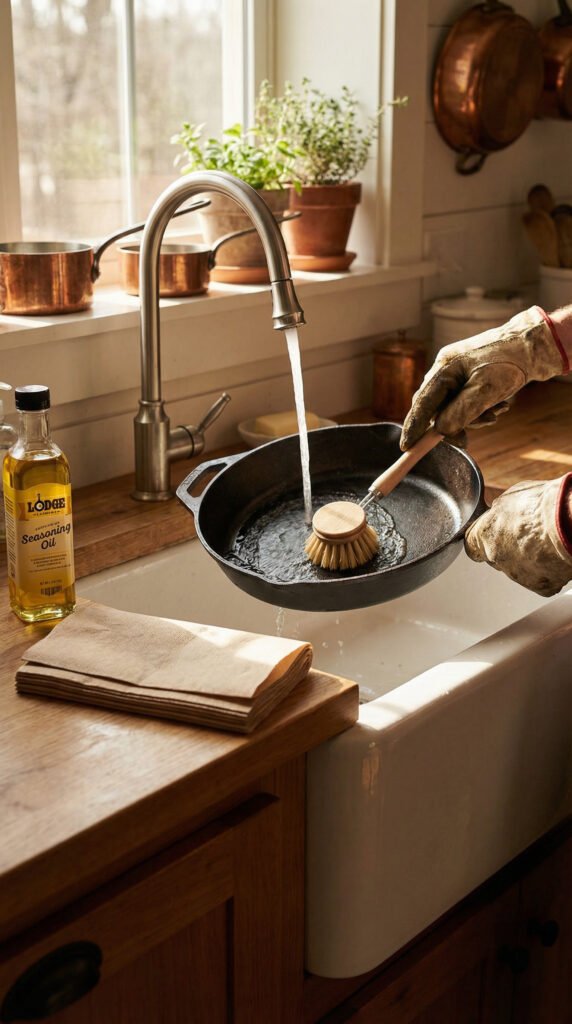
Method 1: The Hot Water Method (Easiest)
Best for:So, Light residue, eggs, pancakes, general cooking
Steps:
- Let pan cool 5-10 minutes (don’t rinse hot pan!)
- Run HOT water over pan
- Use stiff brush or sponge to scrub
- For stuck bits: sprinkle coarse salt, scrub with paper towel
- Rinse thoroughly
- Dry IMMEDIATELY with towel
- Place on warm burner for 2 minutes to evaporate all moisture
- Rub thin layer of oil (any cooking oil) on surface
- Store
Time: 3 minutes
Method 2: The Soap Method (Yes, It’s Safe!)
Myth busted: Modern dish soap WILL NOT ruin your seasoning! Old soap had lye (which stripped seasoning). Modern soap is pH neutral.
When to use soap:Honestly, Greasy foods, fishy smells, sticky residue
Steps:
- Let pan cool slightly
- Add small drop of dish soap
- Scrub with sponge (soft side – no steel wool!)
- Rinse thoroughly
- Dry immediately
- Heat on burner 2 minutes
- Rub with oil
Important: “Small drop” = pea-sized amount. You don’t need much!
Method 3: Chain Mail Scrubber (My Favorite)
Best for: Stuck-on food without scratching seasoning
What it is: Stainless steel chain mail ($10 on Amazon) – looks like medieval armor!
Why it’s better:
- Removes stuck food easily
- Doesn’t scratch seasoning
- No soap needed
- Lasts forever (I’ve had mine 8 years)
How to use:
- Run hot water over pan
- Now, scrub in circles with chain mail
- Even badly stuck food comes off!
- Rinse, dry, oil
Deep Cleaning (For Stuck-On Messes)
When you need this: Burned-on food, sticky residue, thick crud
The Boiling Water Method
Steps:
- Add 1-2 inches water to pan
- Bring to boil on stove (5 minutes)
- Stuck food will release from heat
- Use wooden spatula to scrape while simmering
- Dump water, scrub with brush
- Rinse, dry, oil
Pro tip: Add 2 tablespoons baking soda to water for extra cleaning power!
The Salt Scrub Method
For really stubborn spots:
- Sprinkle ¼ cup coarse salt in pan
- Add 2 tablespoons oil
- Scrub hard with paper towel or cloth
- Salt acts as abrasive (like sandpaper)
- Wipe out salt/oil mixture
- Rinse if needed
- Dry and re-oil
How to Season Cast Iron
So, what “seasoning” actually is: Polymerized oil bonded to iron. Creates non-stick surface AND rust protection.
When to season:
- After removing rust
- When food starts sticking more than usual
- When pan looks dull/gray (not black/shiny)
- So, 2-3 times per year for maintenance
Honestly, the Oven Seasoning Method (Best Results)
Best oils to use:
- ✅ Flaxseed oil (most durable, but expensive)
- ✅ Grapeseed oil (great budget option)
- ✅ Canola oil (works fine)
- ❌ Olive oil (too low smoke point)
- ❌ Butter (contains milk solids – goes rancid)
Steps:
- Wash pan thoroughly with soap and water
- Dry completely
- Honestly, preheat oven to 450°F (or highest setting)
- Rub thin layer oil over ENTIRE pan (inside, outside, handle)
- Now wipe OFF excess oil with paper towel (this is critical!)
- It should look like there’s barely any oil
- Place pan UPSIDE DOWN on middle oven rack
- Put foil on bottom rack (catches drips)
- Bake 1 hour
- Actually, turn off oven, let cool in oven 2 hours
- So, repeat 3-4 times for best results
Why upside down? Prevents oil from pooling in pan (which creates sticky spots).
Why wipe off excess?So, Too much oil = sticky, gummy coating. Less is more!
✅ Pro Tip: Each layer is super thin. You need 3-4 coats to build good seasoning. Now, it’s better to do 4 thin coats than 1 thick coat!
The Stovetop Seasoning Method (Quick Touch-Up)
When to use: Quick maintenance, not full reseasoning
Steps:
- Clean and dry pan completely
- Honestly, heat pan on medium-high 5 minutes
- Add 1 tablespoon oil
- Use paper towel (held with tongs!) to spread oil around
- Honestly, heat until smoking slightly (oil polymerizing)
- Wipe out excess oil
- Turn off heat, let cool
Time: 10 minutes
Results: Good for maintenance, not as durable as oven method
Removing Rust
Rust happened because: Pan stayed wet too long or was stored in humid area.
Good news: Rust is 100% fixable! Cast iron can’t be “ruined” – only temporarily damaged.
Light Rust (Orange Spots)
Fix:
- Sprinkle coarse salt on rust spots
- Cut potato in half (yes, really!)
- Dip potato in salt
- Scrub rust with potato
- Potato’s oxalic acid + salt removes rust
- Rinse, dry, reseason
Honestly, heavy Rust (Pan Orange/Brown)
The Vinegar Bath Method:
- Mix 50/50 white vinegar and water
- Submerge pan completely
- Soak 1-8 hours (check every hour)
- Once rust loosens, scrub with steel wool
- Rinse thoroughly (vinegar can etch iron if left too long!)
- Dry immediately
- Actually, season 3-4 times (oven method)
Don’t soak longer than 8 hours! Vinegar can damage iron if left too long.
Extreme Rust (Looks Like Junk)
The Self-Cleaning Oven Method:
- Place pan in oven
- Run self-clean cycle (burns off ALL seasoning and rust)
- Let cool completely
- You now have bare metal (gray color)
- Wash with soap
- Season 4-5 times
Warning: This is nuclear option. Only use for severely damaged pans. Can cause warping in rare cases.
Fixing Common Problems
Problem: Food Sticking
Causes:
- Seasoning wearing thin
- Pan not hot enough before adding food
- Moving food too soon
Fixes:
- Build seasoning:Now, Season 2-3 times (oven method)
- Preheat properly: Heat pan 5 minutes before cooking
- Test heat: Water droplet should sizzle and evaporate in 2 seconds
- Actually, let food release naturally: Don’t force it – when ready, it releases easily
Problem: Sticky/Gummy Surface
Cause: Too much oil used during seasoning (it didn’t polymerize – it pooled)
Fix:
- Heat oven to 450°F
- Place pan upside down
- Bake 1 hour (sticky oil will bake off)
- Let cool
- Reseason properly (remember: WIPE OFF EXCESS OIL!)
Problem: Black Residue on Paper Towel
Cause: Loose carbon deposits from cooking (totally normal!)
Fix: None needed! This is just loose seasoning particles. Not harmful. Will stop after a few uses.
Problem: Uneven Seasoning (Shiny and Dull Spots)
Cause: Some areas more seasoned than others
Fix: Just keep using it! Cooking naturally evens it out. Or do 2-3 oven seasoning cycles.
Storage Tips
Best Storage Practices
- ✅ Store in dry place (not under sink!)
- ✅ Leave lid off if storing with lid (prevents moisture trap)
- ✅ Place paper towel between stacked pans (prevents scratching)
- ✅ Store with thin layer of oil (rust protection)
- ✅ In humid climates: store in oven or add silica gel packet
Don’t Do This
- ❌ Store wet (instant rust)
- ❌ Store in humid basement
- ❌ Stack heavy items on top (can crack)
- ❌ Store without oil coating
Foods to Avoid (At First)
Until your seasoning is well-established (20-30 uses), avoid:
- ❌ Acidic foods (tomato sauce, vinegar dishes, citrus)
- Honestly, ❌ Long-simmering dishes (breaks down seasoning)
- ❌ Delicate fish (will stick)
After pan is well-seasoned, you can cook ANYTHING! Including acidic foods (just don’t store food in pan).
Best Foods to Build Seasoning
Cook these often in new cast iron:
- ✅ Bacon (fat helps seasoning)
- ✅ Fried chicken
- ✅ Steaks
- ✅ Cornbread
- ✅ Fried potatoes
- ✅ Any fatty food
Fat + heat = improved seasoning!
So, cast Iron Myths (Busted)
| Myth | Truth |
|---|---|
| “Never use soap!” | Modern soap is fine. So, won’t hurt seasoning. |
| Now, “It adds iron to your food” | Now, only trace amounts. Not enough to matter (unless anemic). |
| “Never wash it” | ALWAYS wash it! Honestly, food residue goes rancid. |
| “You can’t cook tomatoes” | You can! Just don’t store acidic food in it. |
| “Dishwasher ruins it” | TRUE! Never dishwasher – strips seasoning and causes rust. |
Quick Reference Cheat Sheet
| Situation | What to Do |
|---|---|
| After light cooking | Hot water + brush → dry → oil |
| After greasy cooking | Now, hot water + drop of soap → dry → oil |
| Stuck food | Well, boil water in pan → scrape → dry → oil |
| Light rust | Salt + potato scrub → reseason once |
| Heavy rust | Actually, vinegar bath → reseason 3-4 times |
| Sticky surface | Now, bake upside down 1 hour → reseason thin |
Ready to Start Cooking?
🍳 Need Cast Iron Cookware?
Lodge makes the best value cast iron. Pre-seasoned, ready to use, lasts 100+ years.
⭐ Trusted since 1896 | Made in USA
Bottom line: Cast iron care is MUCH easier than the internet makes it seem. Clean it, dry it, oil it. That’s 90% of maintenance!
Disclosure: This post contains affiliate links. If you purchase through these links, we may earn a small commission at no extra cost to you. Care instructions based on Lodge recommendations and 15+ years personal experience. Information accurate as of November 2025.
So, 🛒 Check Current Price:
Well, 🛒 Check Current Price: